
Design 1: Learning Pathway
Introduction
This Learning Pathway shows my process as I reflected upon how and why I came to be embarking upon the Permaculture Diploma, and what I wish to gain from the experience. Articulating my motivations in this way helped me consider potential designs that might best support my goals while working with my current resources and limitations. The process also gave me a better understanding of how I can best support my own effective learning throughout the diploma and beyond.
Contents & Considerations of Ethics and Principles
I began with a rough illustration of the life experiences and influences which have contributed to my decision to do the diploma.
I made an attempt to express my motivations and hoped for outcomes, then have used the GROWER structure to help me articulate my goals and the actions needed to get there.
I have drafted a rough outline of which designs I might do over the next two and a half years, and will set regular review points to consider how my learning is progressing. These reviews will focus on whether my activities and learning continue to support my hoped for outcomes and goal, and whether my approach to the diploma continues to respect the permacultural ethics of:
People Care (am I looking after my clients? Do I still have time for my family? Am I respecting and acknowledging those I am learning from? Am I stressing myself out unduly?),
Earth Care (are my designs helping me learn how to be a better earth citizen? Do I still have time and energy to look after the ground where I stand?)
Fair Shares (What value can I pass on to others from these experiences and lessons? Am I recording this adequately enough to be of use to my future self?)
Constructing this learning pathway involved quite a bit of personal reflection - looking to the past for patterns, then checking in with the present self in order to effectively evaluate what is desired and possible in the future. During the reflective process for this design I found the following permacultural principles to be relevant and helpful:
Design from pattern to detail - observing the overall pattern of my life so far brought awareness to the origins of my present motivations and hopes. This enabled me to choose a selection of design types and envisage a route through the diploma that is most likely to meet my own personal goals - a task that would otherwise be nebulous and potentially overwhelming without the initial observation of one’s own life pattern.
Use small and slow solutions - recognising the challenges and limitations currently in effect due to the Covid-19 lockdown and my own current circumstances, made me feel disappointed that collaboration would be more difficult, as would learning from others in person - two things I was very much looking forward to. But on reflection I saw that many of the skills I wish to learn, or perspectives I wish to gain, can also be done using resources on my own doorstep. Perhaps not as glamorous or expansive, but there is valuable learning there, nonetheless. This principle reminded me that my portfolio doesn’t have to be a shiny and perfect finished product within the time I take to do the diploma. The diploma is the beginning of a lifelong learning process, and so I took a deep breath resolved to take this journey one small, slow step at a time.
Creatively use and respond to change - again, the current lockdown scuppers a lot of my erstwhile diploma-related dreams (i.e. in terms of having an excuse to see and interact with other permaculture operations first hand). However, it also presents new opportunities. This is a great chance for me to focus on resources closer to home - many of the designs I am considering will help me shape the land and lives that we have here. Additionally, many businesses will have to adapt considerably to a new social world post-Covid. As the supply chains and social infrastructure we usually take for granted come under considerable strain, more people are looking for new ways of being and doing business. This is a design opportunity if ever there was one, and I am aiming to do a collaborative (business) design as well as designing my own resilient business plan, towards the end of the diploma. In the meantime, I will have the opportunity to see how Covid effects our world, and consider helpful responses to it.
And finally, the principle that will continue to be relevant as this design is implemented:
Apply self regulation and accept feedback - frequent self-evaluation, as well as evaluation and feedback from my tutor, is an essential part of the learning pathway design. This evaluation will help me to assess whether I continue to respect the ethics mentioned above, and whether I am remaining true to my goals. This will, in turn, continue to shape how I progress through the diploma. This principle was also helpful in drawing my attention to when I was taking too much time on this design - stop being perfectionist and get on with it!
Getting here
I first heard about and was attracted to the idea of Permaculture back in 2008 in the USA. I’d gotten involved in a young and trendy urban agricultural scene, and a few folk had mentioned the P word. I was intrigued, so headed off to a conference where I met a lot of radical people and ate some pretty spicy vegan food. But the thing which grabbed my attention was the philosophy that tied together an otherwise seemingly random conference programme of wild beekeeping, DIY mushroom growing, subterranean housebuilding, and the philosophy of political rebellion. From what I could understand, Permaculture was less of a doctrine and more of a philosophy of compassion, it was about embracing diversity and learning to be comfortable with multiple contradicting realities (a concept I have returned to many times since).
Something similar has attracted me to the other big educational influences in my life - studying at UniSG in 2011 and learning about Slow Food, and then constructing the first MSc Gastronomy programme in the UK in 2013. There is a common thread that resonates with my own understanding of the world - an understanding that has grown from living in and observing nature as a child, and which developed the more I travelled and encountered our extraordinary world and its bizarre/wonderful inhabitants. Nature is the ultimate teacher in compassion, in the value of diversity and the possibility that all things can coexist without contradicting or conflicting with one another. It is nature - and the desire to reconnect with it - that has drawn me magnetically back to living in the place where I grew up. Being held in this familiar space has given me the courage to seek out this permacultural learning and to make time for it in my life. It does not make me ‘successful’ in the eyes of others, and it won’t necessarily make me any money. The value in doing this diploma is that it helps me draw upon what I have learned and will hopefully also give me the tools to move forward in a positive, constructive way.
Some life experiences and influences that led me to do the Permaculture Diploma
2. Motivations
My last ‘proper’ job was as programme leader and lecturer for the MSc Gastronomy. It was hard work, and I loved it. Through it I was given the precious opportunity to create and deliver something that I was really proud of. But I also learned in the process that working within a densely bureaucratic system was not for me. Ultimately, ‘traditional’ education does not resonate with me, and the energy required to maintain our irregular activist programme within the square space of an institution ended up being too much for me.
I understand the term ‘burnout’ is trendy and overused these days, but I haven’t heard of anything else that better fits what I felt. I was knackered and I knew then, as I know now, that desk jobs, board (‘bored’) meetings, long conferences and air-conditioned offices, make me miserable no matter how much inspiring time I had out in the field or in the classroom teaching.
I learned that I love to teach, and also learned that teaching is not what I thought it to be. The teaching I aspire to is more like that which Miss Jean Brodie describes - a drawing out, rather than a putting in. It turns out that I’m good at it. This is an under-used personal resource; a skill that, along with a good knowledge base and network of interesting and inspiring people, I am frustrated that I no longer use.
In 2018 I bit the bullet and created my own business but try as I might, I just recreated the rod for my own back, and it ground to a halt a year later.
These experiences, along with my deep concern for the state of our world and our own inner worlds, leave me with some pretty clear motivations for doing this diploma.
3. Hoped for Outcomes
I see the diploma as a tool for helping me create a right-livelihood, or to put it in other language - a career that is both sustainable and positively contributes to my own life, to the lives of folk I work with, and to the planet.
With the GROWER structure, I’ve considered what my Goal is, the Reality I’m working with, what my Options are, and finally What I’m going to do. Evaluation and Reflection will come later, and at regular intervals through the diploma.
4. Goal
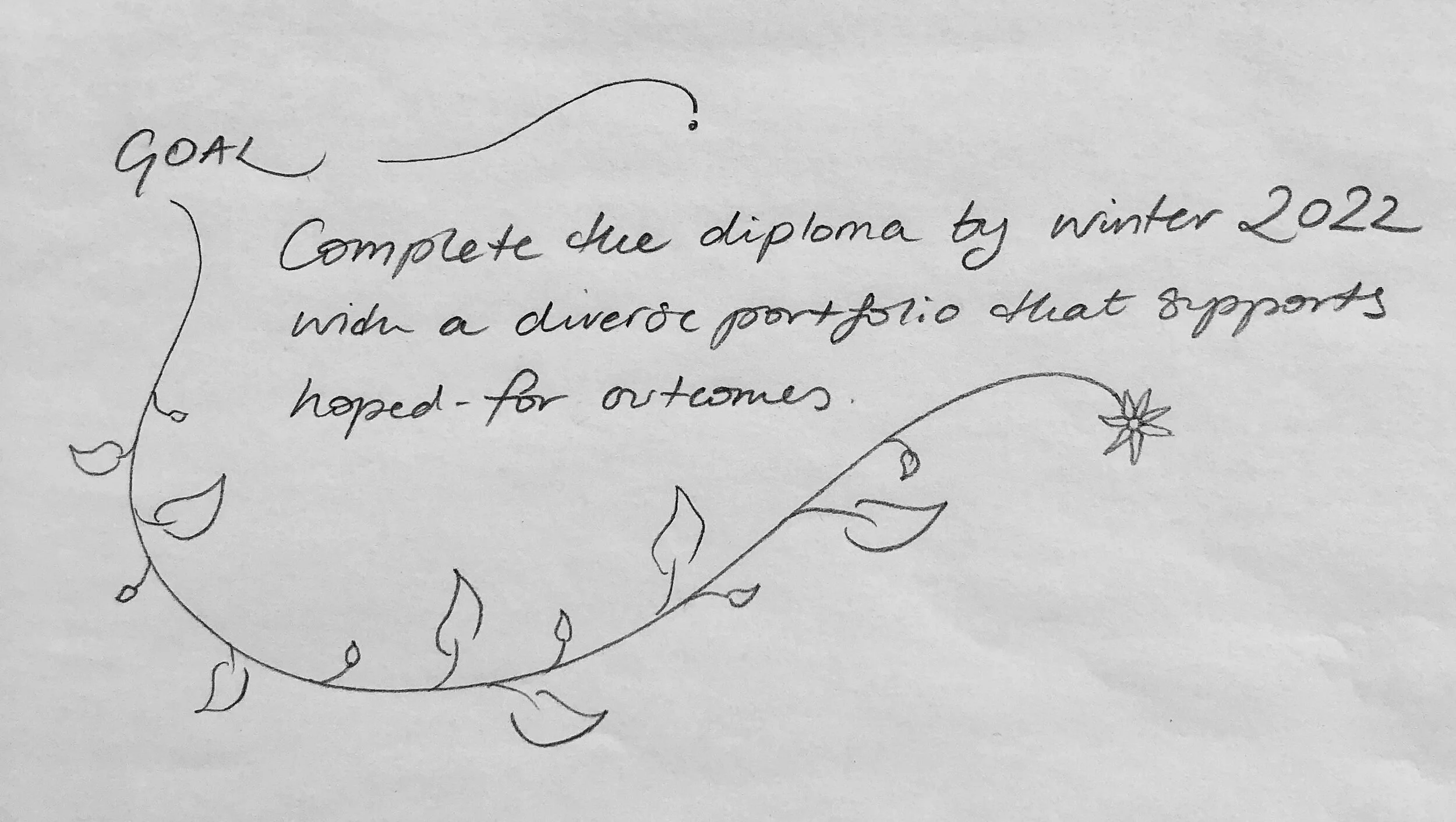
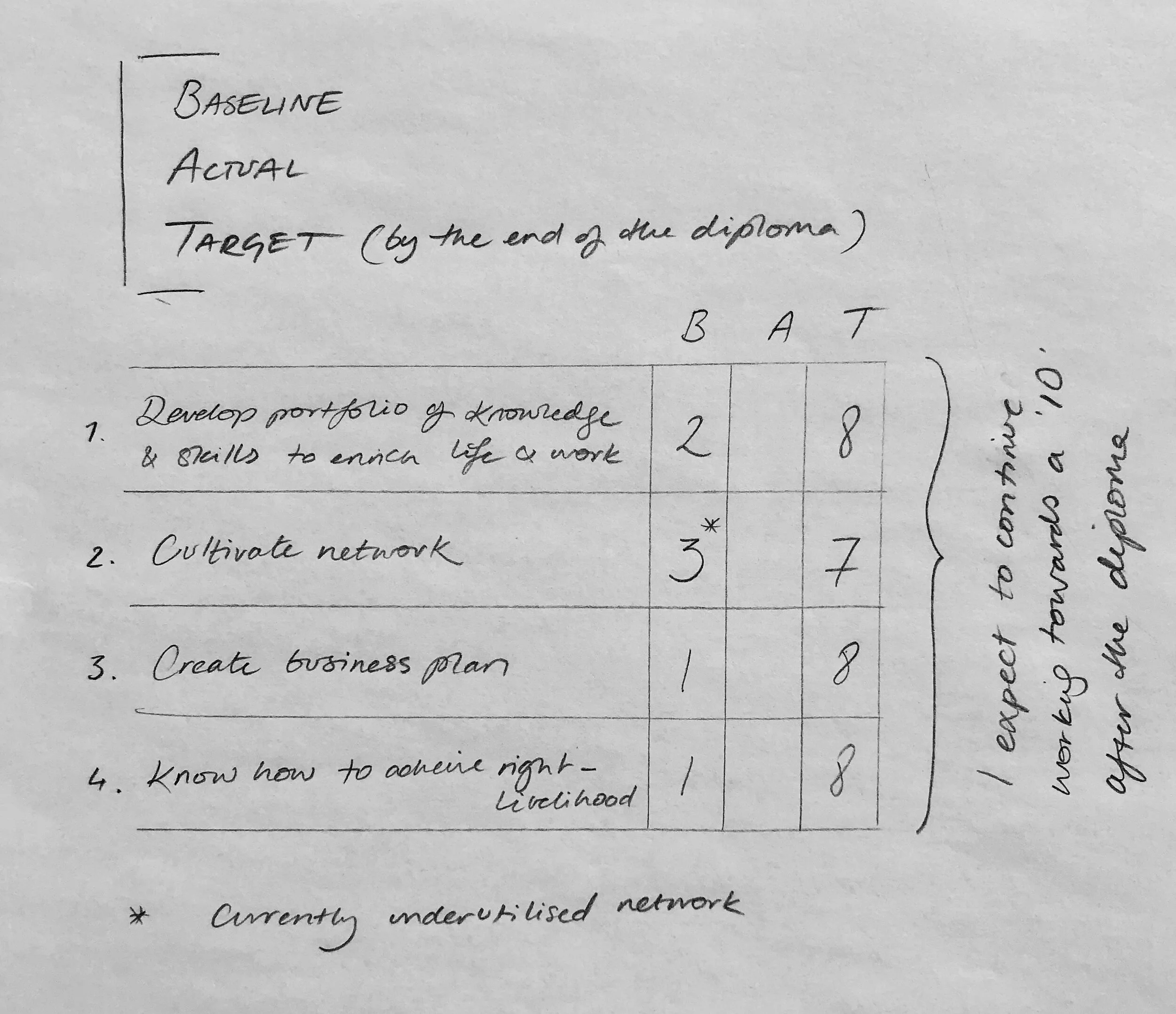
Baseline - Actual - Target
I've also used the BAT structure to help me think about where I am now, and where I want to get to. I was subconsciously thinking of myself as a complete beginner, starting this journey with no resources. This left me feeling intimidated and devoid of the confidence to start. Realising that I have resources to draw on, and also that the end of the diploma is not the end-point, makes this all seem more doable.
5. Reality
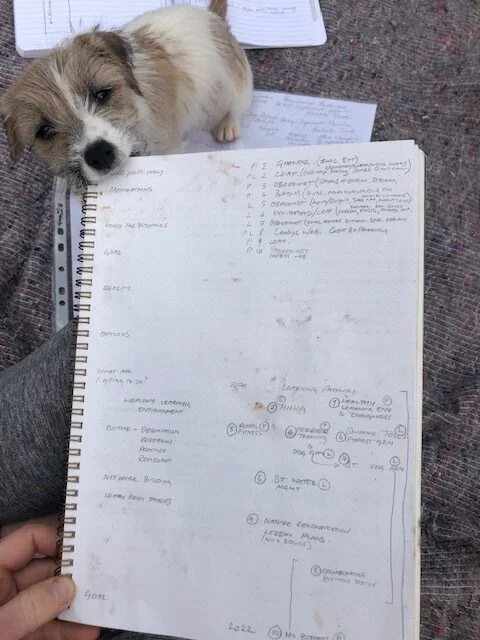
Humphrey ‘helping’ me with my learning pathway design.
I’ve applied a rough SWOC analysis to assessing the reality that I’m working with. There are certainly some challenges at present, most notably that we are in the midst of the Coronavirus pandemic which severely limits movement and direct human interaction. Acknowledging and working with such limitations as well as my own weaknesses, is key if this diploma experience isn’t going to be an endless series of frustrations.
I also have strengths and opportunities that need to be acknowledged. Some of the challenges are also opportunities. One such positive challenge is my new puppy - Humphrey - who does not like me spending too long on anything that isn’t him, and is intent on eating anything within biting distance. Meeting his needs as well as my own is great material for a design, I think.
Reality - conceptualised into SWOC
6. Options
These could be endless, but here are a few.
7. What am I going to do?
Thinking about how I can work with reality, navigate the challenges, harness my strengths and take the weaknesses into account, and then choose options that can meet my hoped-for outcomes. The next stage will be to put these into some manageable order in order to tackle them most efficiently. Conceptualising a potential timeline for the next couple of years (next step) helps with this.
8. Rough Design Timeline
Some potential designs and timeline which could support my hoped-for outcomes and work within the parameters that I have. This image depicts when I think observation and research for the design would begin, and when I would hope to have it completed for review by my tutor. A short description and rationale for each of these designs has been provided to my tutor.
I fully expect the timings and content of these to change as I go, as circumstance and opportunity will also change. In taking the time to review my learning pathway every season, I should be able to determine which designs to pursue next.
9. Evaluate and Reflect
Evaluating the effectiveness of this Learning Pathway is something I will do after each design is submitted to my tutor, or if I reach an impasse with a design and need to reassess my direction. As indicated above, this will involve assessing whether or not the implementation of the design continues to adhere to permacultural ethics, and whether it remains effective within its own right (i.e. am progressing as anticipated and working towards my hoped-for-outcomes). I anticipate the specifics of the design (which designs are ultimately chosen, timing of design submission, etc.) may change over time, but appropriate changes will be identified and implemented via this evaluation process.
Designing a learning pathway has been a reflective process in and of itself. It required me to really reflect on my motivations for doing this diploma and where those came from. The experience of approaching this design was not a comfortable one and it drew my attention to my tendency to procrastinate, to become overwhelmed (exacerbating the tendency to procrastination), and to aim for perfection (which potentially prevents anything getting finished). But as I pulled this design together, the concept of ‘good enough’ really helped me to crack on and produce something I was happy (enough) with and which will be of use to my future self. These reflections also highlighted the need for me to work on creating a healthy learning environment as my next design.