
Designing a Learning Pathway
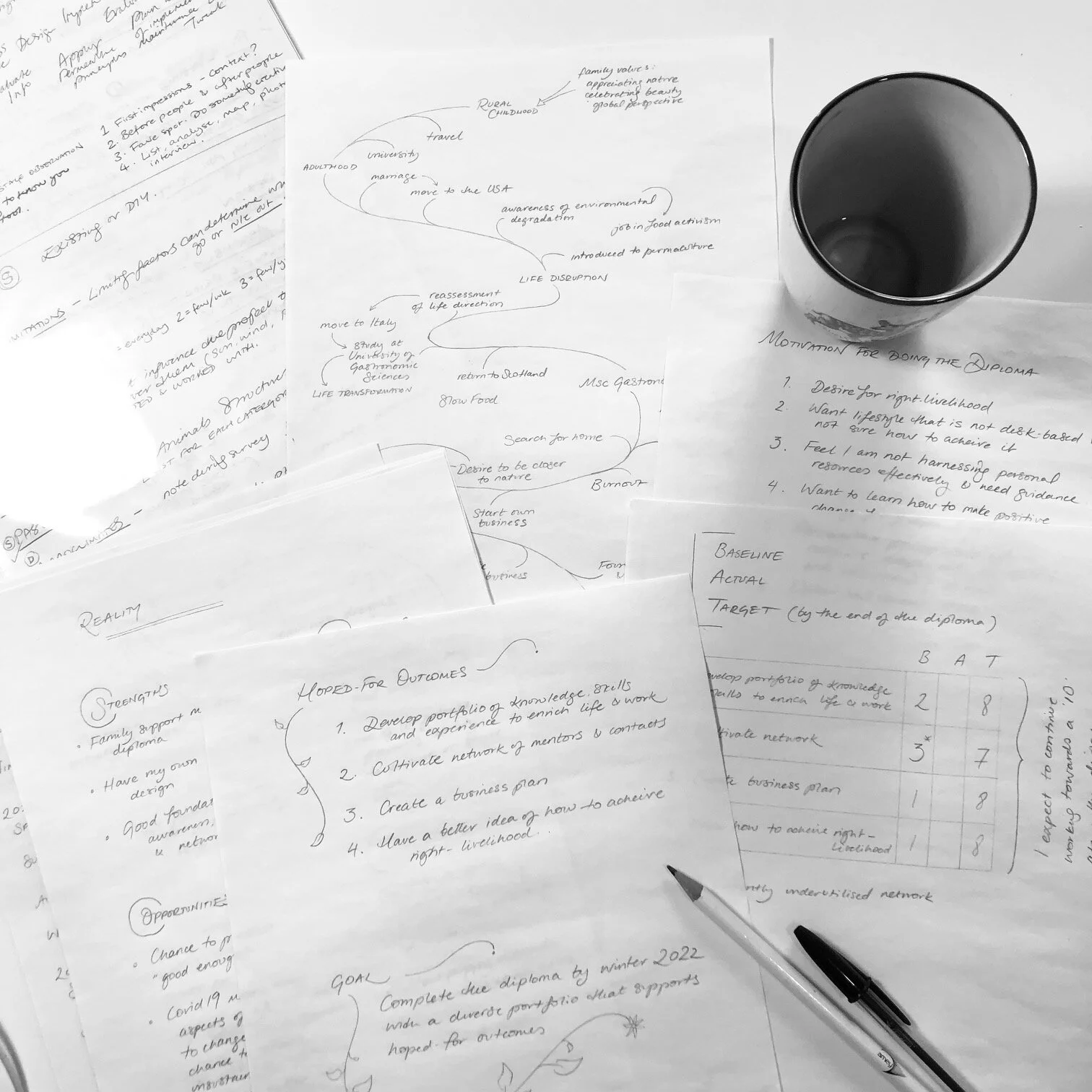
Hundreds of bits of paper and lots of coffee.
The Permaculture Diploma is a self-led learning experience that occurs over a minimum of 2-years and culminates in the presentation of a portfolio of 10 designs. The designs should be diverse in subject and format, harnessing a variety of permacultural design tools and all adhering to permaculture ethics and principles.
Many diploma students take more than 2 years to complete the diploma. There are no deadlines or assessments set by an external body, and so it is easy to let diploma work slip down the list of priorities. For that reason, I’ve been told that its wise to design a ‘learning pathway’ as the first project. This should take into consideration the motivations for doing the diploma, desired goals and how they might be achieved, what challenges might be faced and how they will be met, and what is needed to support effective learning.
As someone who has supported numerous students in organising and focussing their own learning experiences, this task should have been relatively straightforward for me, and yet it has not been. I officially registered for the diploma in August, and am only now - in the following April - getting round to articulating a learning pathway. I could blame it on life circumstances (buying a house, Christmas, Covid-19, getting a puppy), but actually the truth is that I have prioritised everything else until now because I wasn’t sure how to approach it. The Covid-19 lockdown has finally removed all excuses and given me the kick up the arse that I needed.
There is no set objective for the permaculture diploma. The purpose of doing it is largely determined by yourself and your own circumstances. My own motivations originated as a gut feeling, then I saw it as an opportunity to focus my wandering career. But when it came to writing a learning pathway, I realised I needed more detailed insight and a precise articulation, otherwise I wouldn’t know what I’d need in order to learn.
During this time I went to the Permaculture Diploma Gathering in London and spoke with a lot of folk who had completed or were in the middle of their diploma. There were so many beautiful ideas being discussed, so many insightful and pertinent designs, and some brilliant examples of how folk had overcome their own tendencies to procrastinate. This, and effects of the Coronavirus pandemic, have really inspired me to crack on. Our future - domestically, locally, nationally and globally - is uncertain and feels quite scary. I don’t want to give in to the temptation to hole up in my countryside home and hide from it all. As someone who has been given a fantastic start in life, who is healthy of body and mind, and who already has some life experience, I feel a strong sense of responsibility to arm myself with as many tools, relevant skills, knowledge, compassion and love, as possible. This is what I believe this diploma - this time studying and practicing - can help me achieve. Designing a learning pathway is how to make sure I do this consciously and to the best of my ability.
I’ve begun my design with a quick sketch of some of the points in my life which I think have led me to do the diploma. This is really just for me to remember what i bring to this, and what I can draw upon for guidance from my own self.
Then, there were two things I picked up at the London gathering which I’ve used to shape this design.
The first came from watching the final presentation of a guy called Barry Jones. His (intimidatingly detailed and organised) presentation was full of great tools, but I particularly liked the ‘GROWER’ framework which he used to organise his thoughts:
Goal
Reality
Options
What am I going to do?
Evaluate
Reflect
I’ve used this to shape my Learning Pathway design.
The other takeaway was the concept of ‘Enough-ness’ or things being ‘good-enough’. We can tweak and revise a design or a piece of work forever and never be happy with it. This is something I learned as a child watching my dad paint. He is never satisfied with his work, but has learned to recognise a time when it is good enough. Being someone whose self-confidence has dwindled in conjunction with my career, I am increasingly loathe to share or show anything I do, hampered by the conviction it is not ‘good enough’. But something IS better than nothing, and what I learned from many of the other diploma students is that just getting on with it can help you grow and improve. And ultimately, if you seek perfection every time, you will never finish the diploma. Learning is a process, not a destination. On my PDC (Permaculture Design Course) one of the tutors said, ‘the day you stop learning is the day you die’ (metaphorically, I presume). And so I have to learn that something is finished when it is ‘enough’, and that the end of the diploma is only the beginning of real learning. This is also where the two last parts of GROWER come into it - Evaluation and Reflection of the design means that it is constantly developing, changing and improving, much like a garden or ourselves.
The Learning Pathways design - and hopefully all the other designs that follow - is a work in progress to be applied to the diploma and beyond.