
"Re-imagining the Walled Garden", Floors Castle, 27th May, 2022
“It was the sweetest, most mysterious looking place anyone could imagine. The high walls which shut it in were covered with the leafless stems of climbing roses, which were so thick that they matted together.”
“…she was inside the wonderful garden, and she could come through the door under the ivy any time, and she felt as if she had found a world all of her own.”
- The Secret Garden - Frances Hodgson-Burnet, 1911
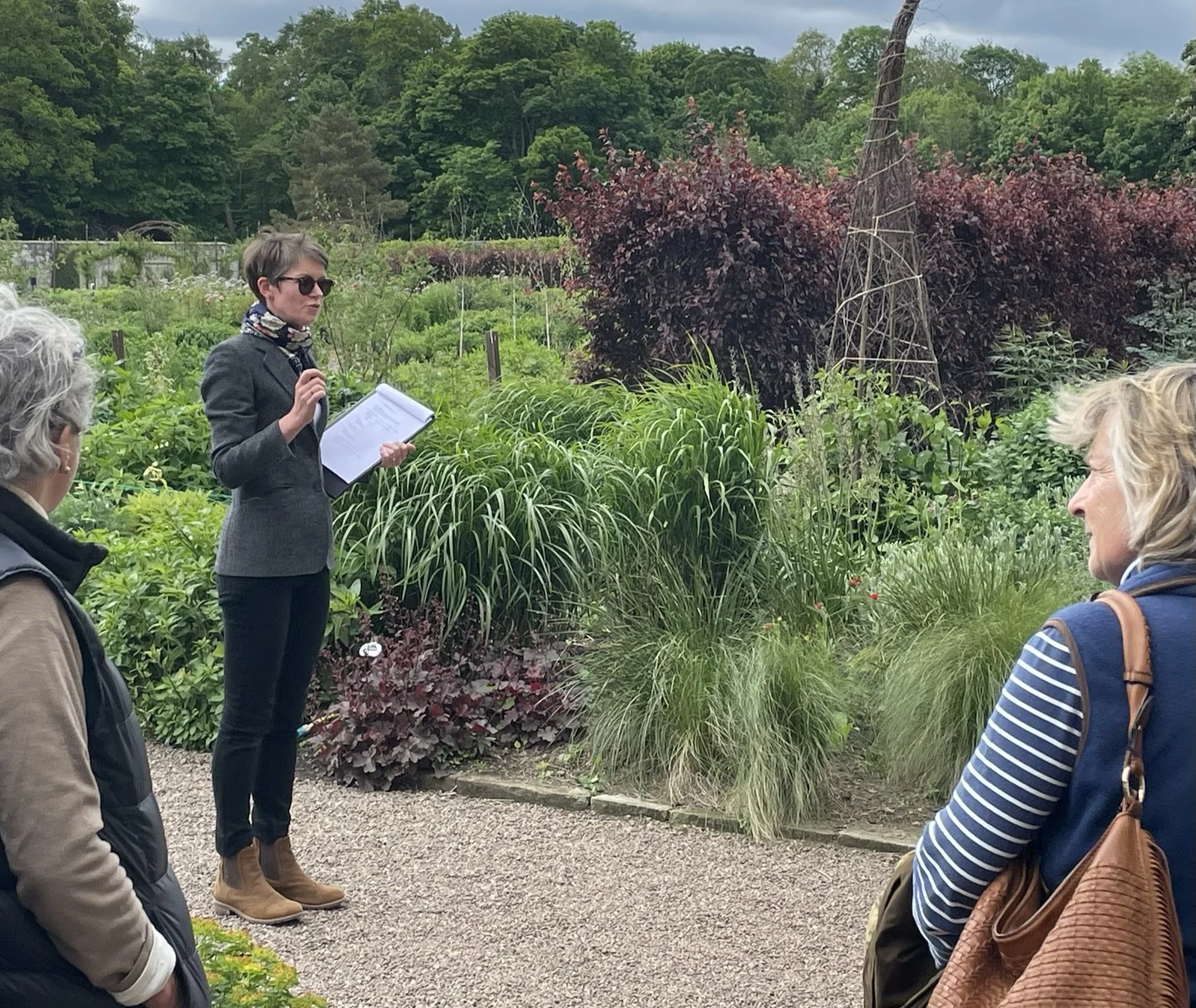
Touring the garden on 27th May, talking about responsibilities of the head gardener and changing employee numbers through the decades.
There is something undeniably enchanting about walled gardens. As in Hodgson-Burnett’s childrens’ story, ‘The Secret Garden’, the four walls seem to contain a world apart from our own into which we can escape.
Like many people, I love a good walled garden, and so I was delighted to be able to host a workshop in the Floors Castle walled garden near Kelso in May 2022. The aim was to create a food-inspired exploration of the past, present and potential of these magical spaces, just as the Floors garden is looking to its own future. Over three hours, we enjoyed a ‘behind-the-scenes’ tour of the garden and its food-growing operations, interviews with the gardeners, all accompanied by history inspired tastings in the Queen Victoria Pavillion and glasshouses.
The event was sold out with more guests squeezing in at the last moment and the discussion was energetic - all suggesting a sustained fascination and enthusiasm even in a time when working walled gardens are rare. Some attendees were considering how best to revive or use a garden they owned, and others brought fantastic historical insight to the discussion. The question of how walled gardens could best be used into the future elicited a surprising variety of answers and even some impassioned debate.
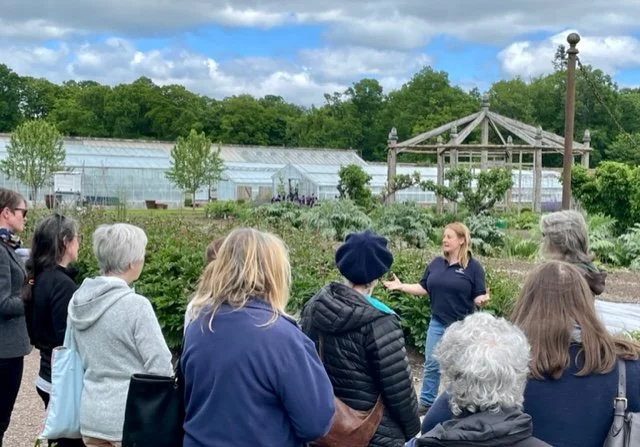
Learning about flower production from gardener and ex-florist, Laura.
For many, the idea of a British walled garden conjures romantic images; rambling, old-fashioned roses and abundant floral borders contrasting with regimented rows of vegetables, all managed with meticulous horticultural skill. It is a cornucopia of creativity, beauty and nourishment, a haven in which humans negotiate with nature.
“And the secret garden bloomed and bloomed and every morning revealed new miracles.”
— The Secret Garden - Frances Hodgson-Burnett, 1911
But what the children in the Secret Garden discover is a long neglected, overgrown place that has been locked and forgotten - and which is sadly closer to the reality of most walled gardens across the UK today.
Once common throughout the UK, walled gardens suffered a sharp decline in the mid-20th century, mostly being demolished or locked up and left to a slow decline. Interest was rekindled in the 1970s by bodies such as the National Trust and by a popular BBC documentary series - ‘The Victorian Kitchen Garden’ - which stirred the nation’s nostalgia for another, possibly simpler, time. But truthfully, while it appeared relaxed and satisfying on telly, managing a walled garden is far from simple and requires significant labour and resources. Even if a new enthusiasm was growing, how walled gardens might be repurposed for the modern world was unclear.
From the 1500s, walled gardens were commonplace and an essential tool for estates large and small. The walls themselves kept wild and unruly nature out, and created microclimates within that enabled year-round production. Growing technologies advanced throughout the 1700’s to include greenhouses, hotbeds and other ingenious season extension methods, enabling the head gardener to place exotic and impressive fruit and vegetables on the table of their employer.
As the UK’s colonial reach expanded and coal became widely available, exotic fruits - most notably the pineapple - became symbols of power, knowledge and exclusivity. They also boasted the wealth of the host, as such fruit required huge amounts of energy, infrastructure, know-how and labour to produce. Expensive foods secured cultural and culinary capital, and as production science advanced through the 1800s the well-appointed walled garden became a key tool in communicating personal success.
“… the garden was no longer a place of beauty, pleasure and relaxation, but also a stage on which to demonstrate one’s intellectual prowess, ones taste and one’s understanding of politics, art and science.”
— This Other Eden - A. WULF, 2012
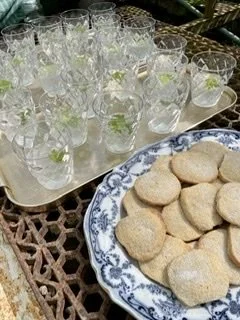
Pelargonium lemonade and pelargonium shortbread served in the pelargonium house!
In its hey-day, the walled garden at Floors Castle grew melons, peaches, grapes, figs, citrus and most certainly pineapples. It was built at the height of British garden fever in the mid-1800s and was driven by an astonishing workforce of 60. The original walled garden, situated near the castle, was demolished in accordance with the fashions of the time and repositioned out of sight to obscure the sounds, smells and hubbub that such a productive space would inevitably generate. It was replete with huge and elaborate glasshouses, rows of cold frames, a tea house built exclusively for Queen Victoria’s visit, tens of apple and pear tree ridges, and meticulously maintained vegetable plots which covered an area many times the size of the current vegetable production area. It also became known for its flowers, providing arrangements and wreaths locally, and breeding carnations for sale commercially.
It is somewhat sad to contemplate the changes that have occurred in a relatively short period of time, leaving a vastly reduced team of 3-4 employees today to manage the same area. But Floors walled garden is to be celebrated as one of the few in the UK to have weathered the storm of estate closures in the 1950s and 60s, when at least one country house was demolished per week. This walled garden has remained open and in production since it opened in 1859 and though its story has never been recorded it can still be read in the remains of potting sheds and boiler rooms, imprints of glasshouses, apple and mushroom stores, and the lovely Head Gardener’s home now available as a holiday let. Today it is undergoing a timely transition to practicing “no-dig” at the hands of head gardener, Lorraine Pearson, in an attempt to restore and revive the soil which has been intensively worked for many decades. Other gardens across the UK are making the same change, generating discussion and debate about how formal gardens should or could be managed, and how much ‘nature’ should be allowed within the walls.
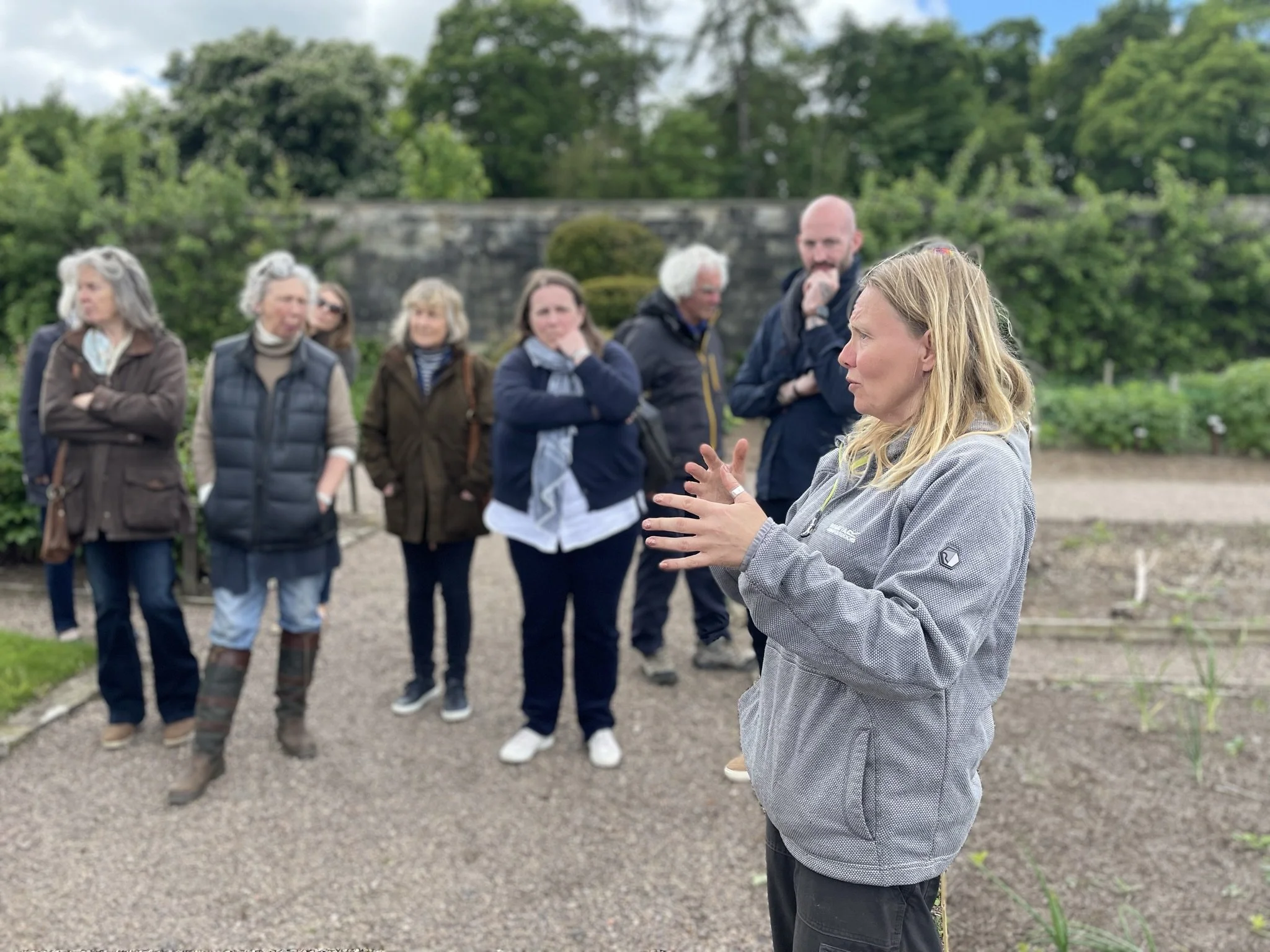
Head gardener Lorraine Pearson, explains the reasons behind transitioning the Floors walled garden to a ‘no-dig’ practice
To prepare for this and other workshops at the Floors walled garden, I was given the opportunity to interview past employees and have brief access to the castle archives. I unearthed some fascinating stories, but also saw how much information must have been lost.
Gardens and kitchens are rarely subjects of historical record. Those who worked in these spaces seldom had the time or inclination to write about what they were doing beyond noting basic accounts and exchanges. There is little we can glean about the details of the Floors Castle walled garden prior to 1957 when living legend, Bill Crozier, began his career at the garden. He assumed the position of head gardener from 1986 until 2008 and has an astonishingly rich and detailed memory of his time there. But the interview with him also revealed how much vital information regarding the artistry, content, technology and practice of a walled garden, is retained solely in the knowledge of the gardeners and embedded in the space itself. Bill had maintained the design and techniques of the Victorian walled garden as closely as he could, guided by the memory of his fellow gardeners and from observing and interacting with the garden over time. No-one had thought to write down or map what happened in the garden because no one had predicted the vast changes that would occur in mechanisation, method and labour throughout the rest of the 20th century.
Though far from being the neglected and overgrown space discovered in Hodgson Burnett’s novel, the lost stories of the Floors walled garden make it a Secret Garden of sorts. But the group gathered for my workshop questioned whether the walled garden should only be considered interesting for its past, or whether the future potential might be a more important and interesting harvest. Today, walled gardens are being reimagined as everything from sculpture gardens to wedding venues, organic cut-flower production to rewilded spaces. Some are exploring their use in addressing issues of climate change and problematic supply chains, while others are providing vital community food education.
Personally, I am most interested in them as spaces in which we intentionally negotiate our relationship with nature. This, of course, is the process of food growing more generally, where we manipulate nature to suit our nutritional needs and cultural beliefs. But the walled garden differs from much of agriculture and from most gardens - something that can be felt intuitively when we walk through the doorway or gate into a walled garden.
In the Secret Garden, the children that discover the forgotten garden have their psychological and physical wounds healed by their interaction with nature. But it is interesting that this only happens within the walls of an old formal garden rather than in the extensive grounds, woodland and moorland surrounding their home. What is it about that enclosed space that provides the ability or the permission to meaningfully connect with nature and eachother? I think that understanding this might hold the key to a successful future for these valuable and beautiful pieces of our heritage.
“…when he first saw and heard and felt springtime inside the four high walls of a hidden garden… the whole world seemed to devote itself to being perfect and radiantly beautiful and kind to one boy. Perhaps out of pure heavenly goodness the spring came and crowded everything it possibly could into that one place.
I’ve seen the spring now and I’m going to see the summer. I’m going to see everything grow here. I’m going to grow here myself!”
— The Secret Garden - Frances Hodgson-Burnett, 1911